7 Best AI Tools for Site Reliability Engineering (SRE) in 2025
Introduction
Site Reliability Engineering teams are juggling hybrid clouds, containerized apps, and a firehose of alerts. AI is finally useful here: it triages faster, reduces noise, and turns sprawling telemetry into decisions. This guide breaks down the 7 best AI tools for SREs in 2025 what they do, when to pick them, and how they fit your stack.
Table of Contents
Quick Comparison Table
Quick Comparison Table
- NudgeBee
- Harness AI SRE
- Resolve
- incident.io
- SRE.AI
- Rootly
- BigPanda
- Extended Analysis: Choosing the Right Fit
- FAQs
- Final Thoughts
Quick Comparison Table
| Tool | Category | Best For | Key AI/Automation Capabilities | Ecosystem Fit |
|---|
| NudgeBee | AI SRE Assistant | Guided troubleshooting & postmortems | Root-cause hypotheses, timeline & summary drafting, context-aware prompts | Works alongside observability + incident mgmt tools |
| Harness AI SRE | Incident Response + Proactive SRE | Triage, response, and prevention across SDLC | AI triage, change-impact hints, Slack/Teams workflows, on‑call, runbook automation; pairs with Chaos Engineering | Tight with Harness platform & CI/CD |
| Resolve AI | Incident Automation | Ticket triage & auto-remediation | Automated runbooks, RCA assistance, workflow orchestration | ITSM-heavy environments |
| incident.io | Chat‑native Incident Mgmt | Slack/Teams collaboration, status pages, on‑call | AI summaries (Scribe), suggested updates, automated timelines & follow‑ups | Slack/Teams‑first ops |
| SRE.AI | AI Reliability Platform | Command-center automation & prediction | Preventive insights, policy/compliance checks, collaboration & handoffs | Enterprise ops teams |
| Rootly | Incident Mgmt & Automation | Incident coordination & on-call | Slack/Teams native workflows, AI summaries, automated timelines, Jira/Statuspage integration | Modern chat-first workflows |
| BigPanda | AIOps & Event Correlation | Alert noise reduction at scale | AI/ML correlation, enrichment, topology/context, unified incident views | Large, multi‑tool estates |
1. NudgeBee
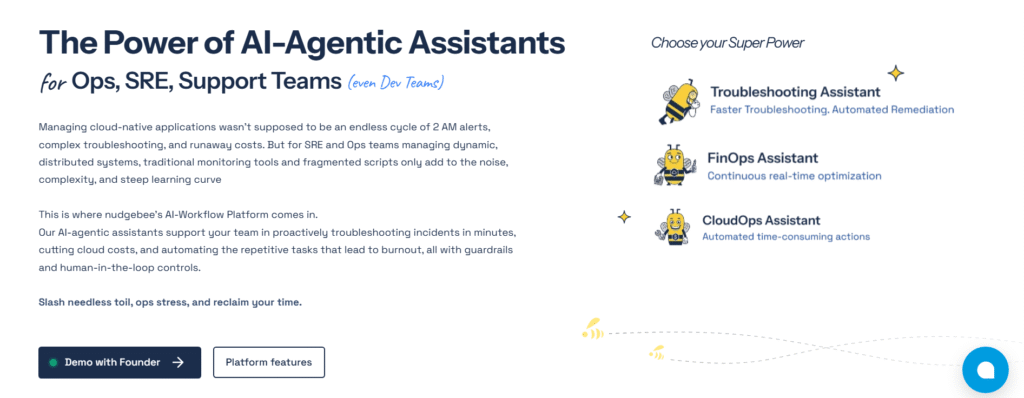
Category: AI SRE Assistant
What it does: A context‑aware assistant to help teams investigate incidents, draft timelines/postmortems, and accelerate mean time to resolve, without hiding the reasoning and human-in-loop controls.
Best for: Teams that want pragmatic AI help while keeping human control.
Why choose it: Explainable suggestions, strong engineering ergonomics, and fast wins on toil.
Pros
- Accelerates RCA and narrative work (updates, postmortems).
- Emphasizes transparency and override, not black‑box magic.
- Plays nicely with existing tools.
Considerations
- Best outcomes come with good context (naming, runbooks, tags).
- As with any assistant, adoption patterns matter.
2. Harness
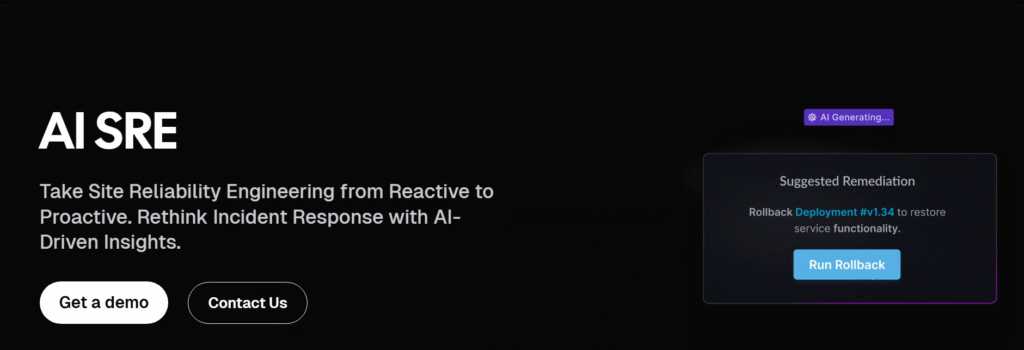
Category: Incident Response + Proactive SRE
What it does: Brings AI agents into incident workflows to triage, diagnose, and coordinate resolution, then improve preparedness with fire‑drills, SLO insights, and chaos‑driven learning. Strong visibility into change events across CI/CD and feature flags.
Best for: Teams already using (or open to) the Harness platform and wanting AI‑assisted, connected incident response.
Why choose it: Deep SDLC context, Slack/Teams integration, runbook automation, and proactive readiness.
Pros
- AI‑assisted triage and change‑impact hints.
- On‑call, Slack/Teams workflows, and service context in one place.
- Pairs well with Chaos Engineering for resilience validation.
Considerations
- Best value when integrated with Harness modules & pipelines.
- Newer AI features evolve quickly—plan governance and guardrails.
3. Resolve AI
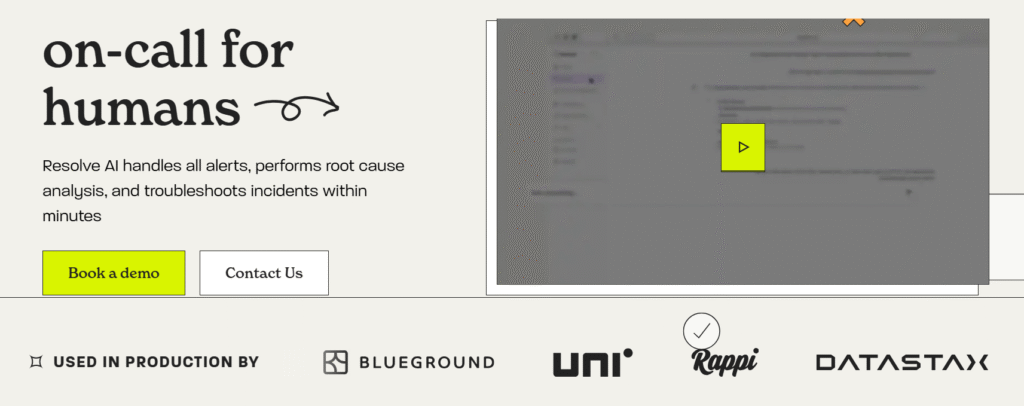
Category: Incident Automation
What it does: Automates repetitive IT/ops tasks from detection to remediation. Executes runbooks, closes the loop, and keeps humans for judgment calls.
Best for: Enterprises with complex ITIL workflows needing measurable toil reduction.
Why choose it: Mature workflows and automation depth.
Pros
- Cuts repetitive manual fixes with policy‑driven actions.
- Strong integration with ticketing & ITSM.
- Helpful for compliance/reporting‑heavy orgs.
Considerations
- Implementation/integration effort.
- May feel heavyweight for small teams.
4. incident.io
Category: Chat‑native Incident Management
What it does: Runs incidents where work already happens—Slack/Teams. Auto‑creates channels, assigns roles, manages status pages, and uses AI (Scribe) to transcribe/summarize bridge calls and suggest updates.
Best for: Teams that want seamless, chat‑first coordination with strong timelines and post‑incident hygiene.
Why choose it: Fast adoption, polished UX, and status page + on‑call built‑ins.
Pros
- Scribe for live call transcription/summaries, plus suggested summaries for updates.
- Status pages and stakeholder comms included.
- Clear pricing tiers and quick setup.
Considerations
- Chat‑first bias: ideal if Slack/Teams centralizes ops.
- On‑call as add‑on depending on plan.
5. SRE.AI
Category: AI Reliability Platform
What it does: Provides a command center to predict/prevent failures, de‑risk deployments, and streamline collaboration with context retention across handoffs.
Best for: Enterprises wanting an AI “safety net” across processes, approvals, and operations.
Why choose it: Prevention‑first posture and orchestration for hybrid teams.
Pros
- Focus on prevention and policy/compliance gaps.
- Designed for cross‑time‑zone collaboration and continuity.
- Integrates into enterprise workflows.
Considerations
- Newer category language; evaluate pilots for concrete ROI.
- Validate integrations and data governance early.
6. Rootly
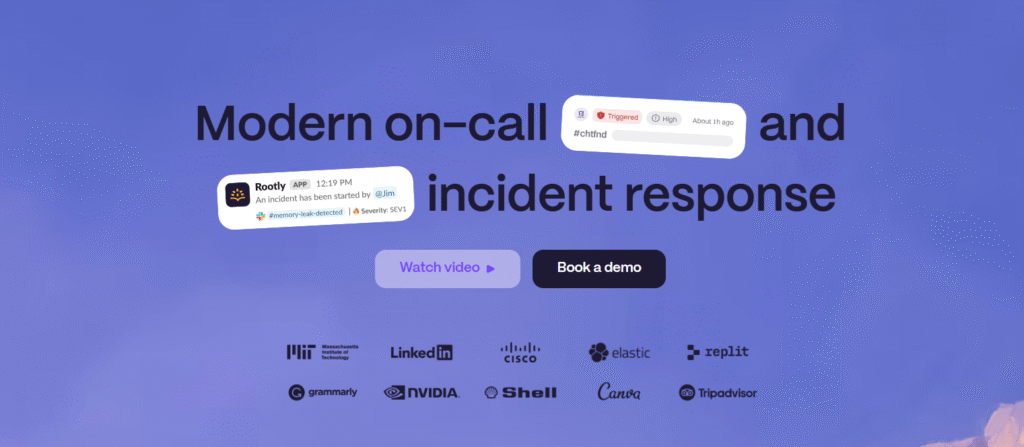
Category: Incident Management & Automation
What it does: Automates incident coordination in Slack/Teams: channel creation, role assignment, stakeholder updates, and timeline generation. Offers on‑call scheduling and integrations with Jira, Statuspage, and more.
Best for: Modern teams who want a chat‑first incident process with automation.
Why choose it: Rootly keeps responders in Slack while automating the admin work of incident response.
Pros
- AI‑powered summaries and automated incident timelines.
- Native chat integrations and status page workflows.
- Rich integration set (Jira, PagerDuty, Zoom, Statuspage).
Considerations
- Geared towards teams that standardize on Slack/Teams.
- Depth of AI features still evolving compared to dedicated AIOps.
7. BigPanda
Category: AIOps & Event Correlation
What it does: Reduces alert noise by correlating signals across tools, enriching with topology/change data, and surfacing probable root causes.
Best for: Large estates with fragmented monitoring and high alert volume.
Why choose it: Proven at-scale noise reduction and faster triage.
Pros
- Powerful correlation & enrichment; unified incident views.
- Integrates broadly; supports complex environments.
- Strong analytics for operations leaders.
Considerations
- Works best when fed with rich topology/change data.
- Requires upfront integration effort and tuning.
Extended Analysis: Choosing the Right Fit
- Ecosystem: Slack/Teams? Atlassian?
- Primary pain: Noise? Triage? RCA? On‑call? Postmortems?
- Governance: Data locations, RBAC/SSO, auditability.
- Time‑to‑value: Pilot scope, integration path, owner team.
- Budget: Per‑user/host vs platform pricing; where ROI lands (MTTR, toil, escalations).
FAQs
NudgeBee
No. They reduce toil and surface insight, but judgment, debugging, and incident leadership remain human.
Most connect to Slack/Teams and ITSM/IM tools (Jira/ServiceNow). BigPanda and Harness also connect into correlation and CI/CD contexts.
AIOps focuses on large‑scale data correlation and automation. AI for SRE emphasizes assistive reasoning, context, and explainability for engineers.
Final Thoughts
2025 is the year AI becomes a practical ally for SREs. Pick a stack that matches your ecosystem and main pain: noise, triage, RCA, or on‑call. Layer tools, don’t force a single vendor to do everything. And keep humans in the loop.